
ICT testers
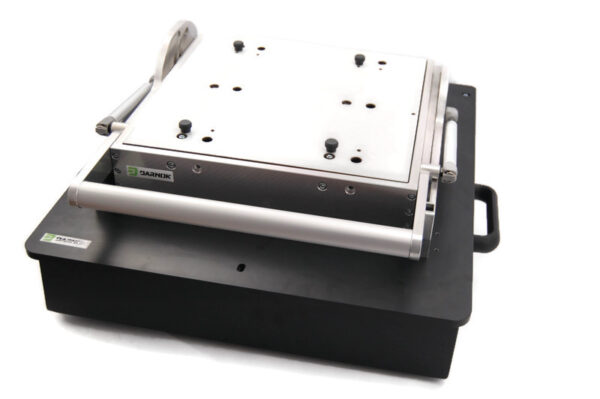
ICT (In-Circuit Test) systems are automated electronic circuit testing systems that check the correctness of component assembly on PCBs (Printed Circuit Boards). These systems are widely used in electronics manufacturing processes to quickly and accurately detect manufacturing defects such as short circuits, open circuits, or incorrect component values.
What is ICT testing?
The ICT (In-Circuit Test) involves testing the electrical properties of each component on a PCB without having to start up the entire device. This is done using special test devices equipped with pins (also called “test probes”) that physically contact the test points on the board.
Additional support: ICT test system mechanics
As part of the implementation of such systems, we also perform work related to mechanics and the preparation of infrastructure supporting testing processes. This includes, among others:
-
Performing mechanics for tests:
- Drilling and modification of test boards: We prepare and customize test boards according to project requirements. Drilling is performed precisely at key points, allowing for accurate alignment of test probes with the PCB.
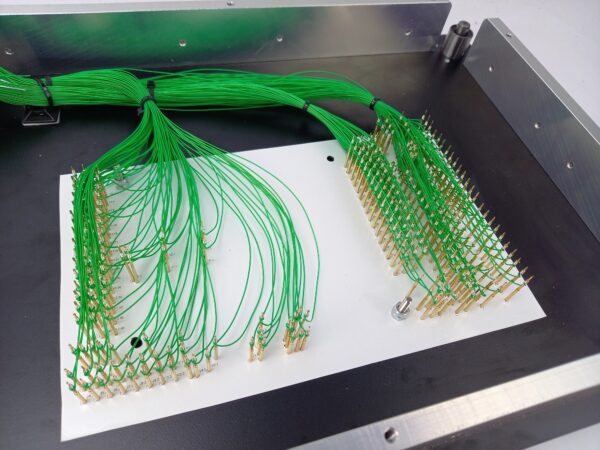
- Cable assemblies: We design and manufacture cable harnesses to connect the circuit under test to the test equipment. The harnesses are created in accordance with the highest standards of reliability and precision to ensure durability and repeatability of tests.
-
Construction of complete test systems:
- We create complete solutions, including dedicated test matrices, holders, clamping mechanisms, and protective elements. The systems are designed with durability, ease of use, and ease of integration with production lines in mind.
Key aspects of operation:
-
Mechanical contact:
- The ICT test system uses a matrix of probes (fixtures) that physically touch specific points on the board. These probes are placed in holders designed and manufactured according to customer specifications.
-
Measurement of electrical parameters:
- The system measures parameters such as resistance, capacitance, inductance, and the correctness of connections between points (short circuits and breaks).
- It also checks the presence, polarity, and values of components (e.g., resistors, capacitors, diodes, transistors).
-
Mechanical and electrical adjustment:
- Based on customer specifications, we customize all mechanical components, such as brackets, enclosures, and cable assemblies, to ensure system reliability in a given production environment.
Advantages of a comprehensive approach:
- Versatility: By performing both mechanical and cable assembly work, we offer full support in the construction of dedicated test systems.
- Precision and quality: All elements – from drilling in boards to cable harnesses – are carried out with the highest accuracy.
- Integration: The comprehensive ICT test systems we deliver are ready for integration into production lines.
- Reduced implementation time: By offering comprehensive services, the customer saves time that would otherwise be spent searching for external suppliers for different stages of the project.
Summary:
ICT test systems are a key tool in the production of modern electronics, and by offering support in the areas of mechanics, cable sheathing, and comprehensive modifications, we are able to provide a complete solution tailored to the specific needs of the customer. Drilling, test board adaptation, and complete test system construction allow for quick and reliable ICT system implementation in any production line.